Rail freight
Rail freight works as a standalone service or as part of a multimodal route. When the volume or weight of the cargo exceeds road limits, rail is an excellent alternative.
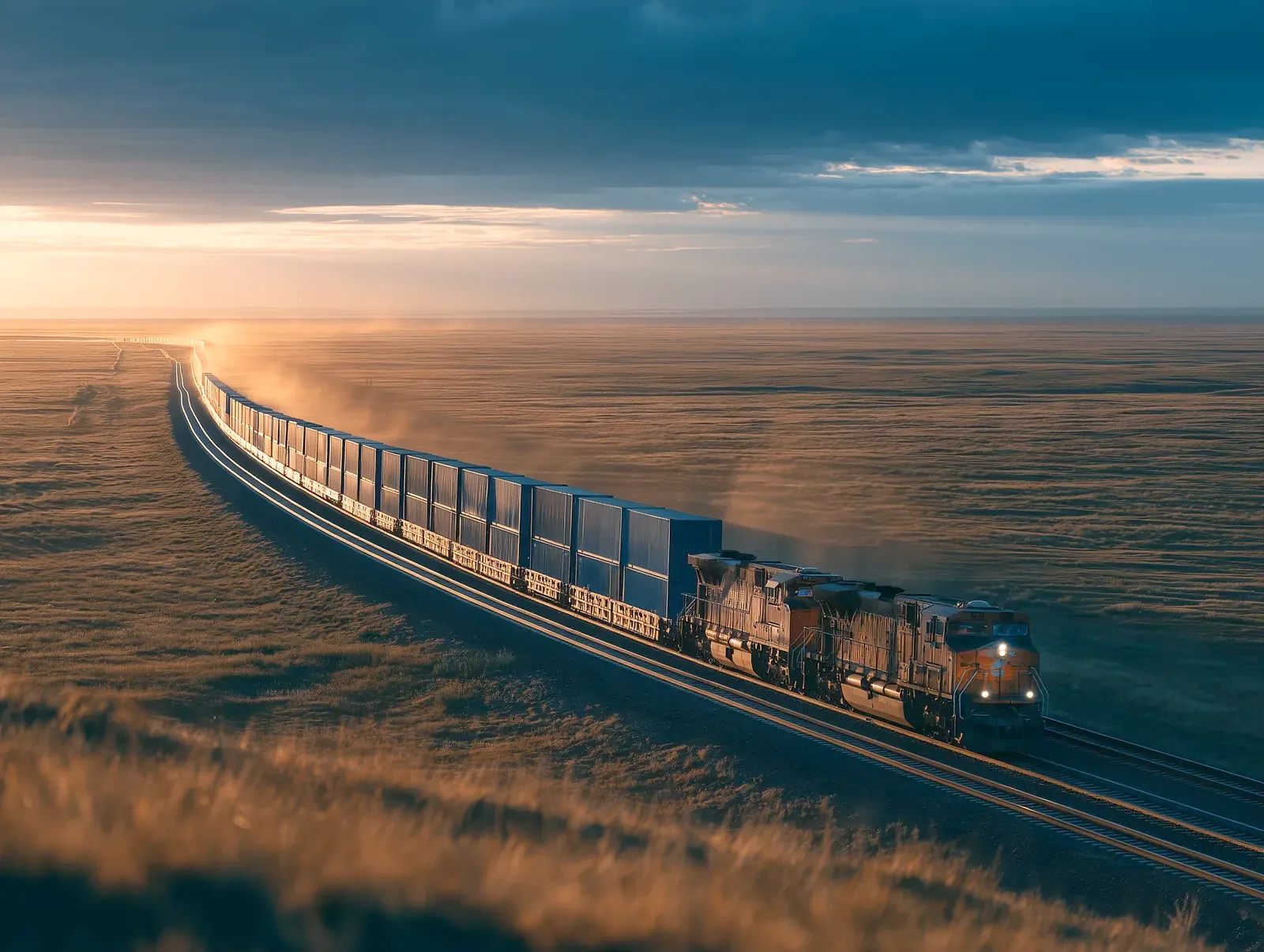
We offer rail as a standalone service or as part of a multimodal route — combined with road for door delivery.
Price: on request
Cargo size: containers 20′, 40′, 40HC; wagon groups and full trains
Transit time: 12–18 days (depending on route and border crossings)
Wagon types: covered wagons — 60–68 t, 120–175 m³; gondolas — 65–75 t, 73–88 m³; platforms (oversized, containers) — 60–70 t
Additional services: trains from Lithuania, Latvia and Poland; daily tracking; customs clearance with experienced customs brokers
When rail beats road
Rail takes over where road limits end. If a shipment is heavier than 24 tonnes or larger than 120 m³, a wagon is often not an alternative but the only sensible solution.
Wagon capacity
Covered wagons carry 60–68 t and 120–175 m³, open wagons 65–75 t and 73–88 m³, and flat wagons for out-of-gauge cargo and containers 60–70 t. We also ship in 20′, 40′ and 40HC containers, in wagon groups or as full trains.
Transit time and what to expect
Transit takes 12–18 days, depending on the route and the border crossings. That is slower than a truck, but for large volumes the price difference usually outweighs the extra days.
Where the trains depart from
We build shipments from Lithuania, Latvia and Poland. First and last mile are coordinated with trucks, so the cargo reaches the door rather than just the station.
How the price is calculated
Rail pricing depends on the wagon type, the route and the season, so it is quoted on request. For an accurate estimate we need the weight, the volume or container type, the loading location and the destination station.
Route and commodity code
The rail route to Central Asia runs in transit through Belarus and Russia, so the same EU transit restrictions apply as for road. It is worth checking the code before planning — our HS code check is free.