Cargo from Europe to Kazakhstan: transit times, documents and how Kazakhstan differs from Uzbekistan
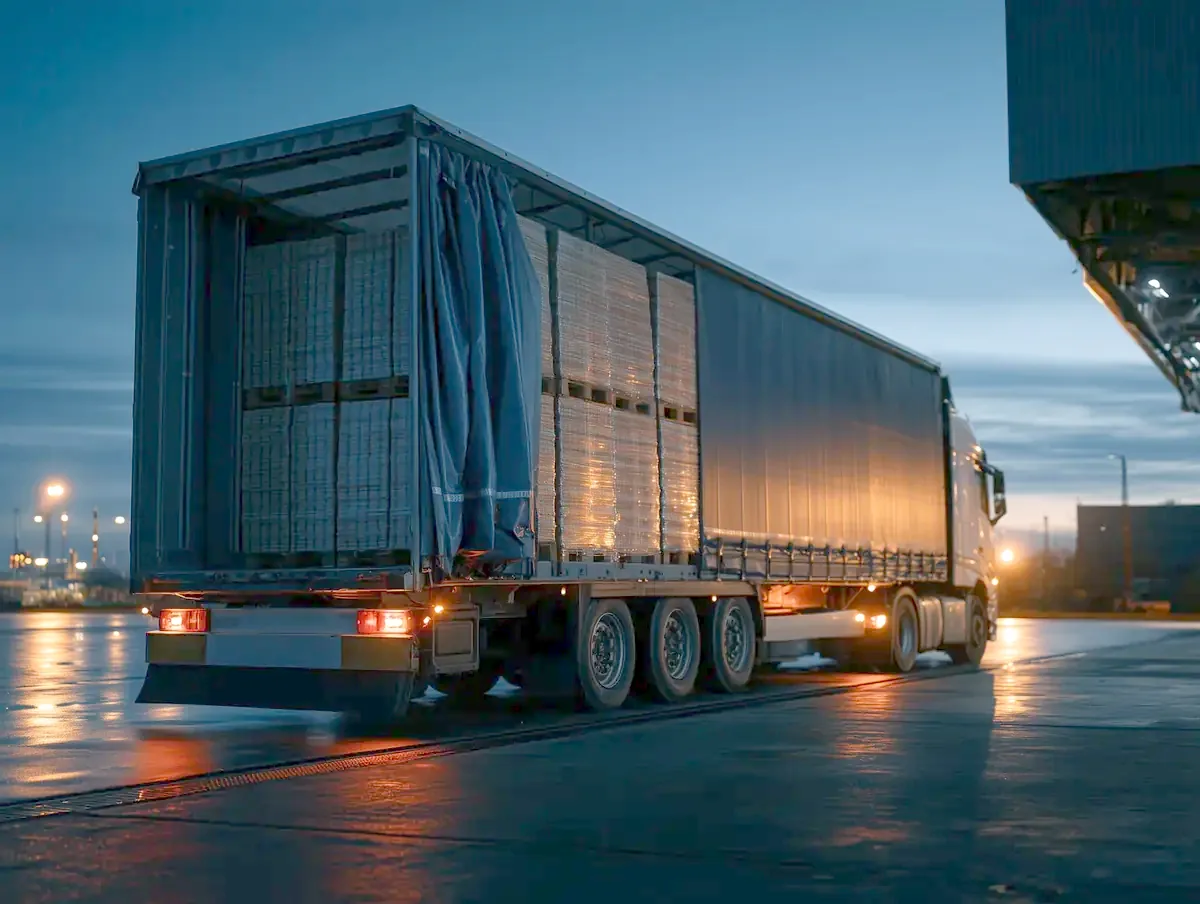
Kazakhstan is in the EAEU, so there is only one customs clearance: after the external EAEU border the truck goes to the consignee with no customs stop at the Russia–Kazakhstan border (an internal EAEU border), and import is cleared by the consignee at the destination customs office under a contract and an invoice in EAEU format.
From the partner warehouse in Vilnius, groupage (LTL) reaches Almaty in 10–14 days and Astana in 9–12 days; a full truck (FTL) takes 8–12 and 7–10 days; the road leg from the EU to Vilnius is added in the quote.
How it works: from the EU supplier to the consignee in Kazakhstan
Collection from the supplier in any EU country, the UK and other countries is available on request; cargo from several suppliers is combined into one shipment with one set of documents.
Groupage cargo is brought to the partner warehouse in Vilnius, consolidated with other cargo for Kazakhstan and Uzbekistan and dispatched on one of the 3–6 trucks that leave Vilnius every week; the minimum consignment is 1 kg or 0.1 m³. A full truck (13.6 m semi-trailer, up to 24 t and 90–100 m³; road train up to 120 m³) is loaded at the supplier's premises and runs direct.
INFOBETA issues the CMR consignment note in Lithuania and, on request for an extra fee, the T1 transit declaration; the EX export declaration is lodged by the shipper in its own country. From there the route depends on the HS code: via Belarus or Latvia, then Russia, to the Kazakh crossings, and from there direct to Astana, Almaty, Shymkent or Aktobe. More about this lane: freight to Kazakhstan and groupage to Kazakhstan.
Transit times: Almaty, Astana and other cities
Transit times are counted from the partner warehouse in Vilnius and depend on the permitted route and customs. To Almaty: groupage 10–14 days, full truck 8–12 days, rail 14–20 days, air 1–3 days express or 2–4 days economy from departure to arrival. To Astana: groupage 9–12 days, full truck 7–10 days, rail 12–18 days, air 1–3 days express or 2–4 days economy from departure to arrival.
The transit time from a supplier in Germany, Poland, the Netherlands or Italy to Vilnius comes on top and depends on the loading city; it is stated in the quote. Shymkent and Aktobe are served door to door, and Karaganda on request; we do not publish separate transit times for them, and the time is stated in the quote.
How Kazakhstan differs from Uzbekistan
The main difference is that Uzbekistan, unlike Kazakhstan, is outside the EAEU and has its own import border. Kazakhstan is an EAEU member: after the external EAEU border the truck goes on to the consignee with no customs stop at the Russia–Kazakhstan border (an internal EAEU border), and import clearance is handled by the consignee at the destination customs office.
Uzbekistan is not an EAEU member, so after EAEU transit (from Belarus or Russia through Kazakhstan) the cargo is cleared again, as an import at the destination customs office (terminal). That, together with the longer distance (Tashkent is reached through Kazakhstan), is why the journey to Almaty or Astana is shorter than to Tashkent.
The consignee's documents differ as well. A Kazakh importer needs a contract, an invoice in EAEU format and, for regulated goods, an EAEU declaration or certificate of conformity (TR CU). An Uzbek importer needs a contract registered in the customs system, an invoice and, for regulated goods, an Uzstandard certificate of conformity.
Common to both countries: veterinary and phytosanitary certificates under Customs Union Commission Decisions No. 317 and No. 318 (EAEU lists) are issued in Lithuania before dispatch, and solid-wood packaging must carry the ISPM 15 mark or be accompanied by a certificate. Since 7 October 2026 Russia has not admitted veterinary-controlled goods from EU companies either for import or in transit, so such goods travel by the southern route via Türkiye, Georgia and the Caspian; the transit time is stated in the quote. For comparison: freight to Uzbekistan.
Border crossings and choosing the route by HS code
Before loading, every HS code is checked against EU Regulations 765/2006 (Belarus) and 833/2014 (Russia), the Russian and Belarusian counter-lists, the EAEU veterinary and phytosanitary control lists and Lithuania's national list of controlled dual-use goods (Resolution No 512). Goods with open codes travel via Belarus or Latvia, then Russia, and enter Kazakhstan at the Petukhovo–Zhana Zhol, Troitsk–Kairak or Sagarchin–Zhaisan crossings.
Goods with restricted codes, which include some equipment and industrial products, do not go via Belarus and Russia; for them the main route is the southern route: Türkiye → Georgia → Baku → Aktau → Kazakhstan. It takes longer; air freight is the other option. Dual-use and sanctioned goods are checked before the booking is accepted. You can check a code before sending an enquiry: free HS code check; the three route options are described in the article three routes to Central Asia.
Rail and air: Almaty, Astana
For heavy regular volumes such as equipment, metal, chemicals and building materials, rail is a good fit: container and wagon shipments from terminals in Lithuania, Latvia and Poland to Almaty and Astana. Transit time from Vilnius is 14–20 days to Almaty and 12–18 days to Astana.
Air freight (1–3 days express or 2–4 days economy, from departure to arrival) is priced by chargeable weight and pays off for compact, high-value cargo: spare parts for a stopped production line, electronics, samples, medical goods. More: rail freight and air freight.
Example: three pallets of spare parts from Germany to Astana
A supplier in Germany ships three pallets of spare parts for machinery. The exporter sends an invoice and a packing list with an HS code for each item: not “machine parts” but exact codes, which are checked against Regulations 765/2006 and 833/2014. The pallets are collected from the supplier on request, brought to the partner warehouse in Vilnius and leave on the next departure (3–6 a week) to Astana.
The exporter, or its customs broker, lodges the EX in Germany; INFOBETA issues the CMR in Lithuania, and the T1 transit declaration on request for an extra fee; the pallets carry the ISPM 15 mark.
The truck passes one of the crossings on the Russia–Kazakhstan border, an internal EAEU border, and drives straight to Astana. The consignee has given their customs broker the contract and the EAEU-format invoice in advance; if the items fall under TR CU, the EAEU declaration of conformity is ready before arrival.
There is no customs stop at the Russia–Kazakhstan border; import is cleared at the destination customs office. The indicative transit time from the partner warehouse in Vilnius is 9–12 days; the leg from Germany to Vilnius comes on top and is stated in the quote. The price comes as a fixed quote within one working day.
What to prepare in advance
- HS codes for each item and a check of whether the goods may transit Belarus and Russia: the code check is free.
- Packing list: weight, dimensions or number of pallets, loading city in the EU and delivery address in Kazakhstan, ready date, special requirements (temperature, ADR, oversized).
- Commercial invoice from the exporter; technical data if needed for the EAEU declaration or certificate of conformity.
- From the consignee: contract, invoice in EAEU format and, for regulated goods, an EAEU declaration or certificate of conformity (TR CU).
- For products of animal and plant origin, a veterinary or phytosanitary certificate issued in Lithuania before dispatch; wooden pallets with the ISPM 15 mark.
This article is not legal advice: before shipping, check the current EU regulations and the requirements of the destination country, or write to us and we will reply within one working day.
FAQ
Who handles import clearance in Kazakhstan, and where?
The consignee or their broker, at the destination customs office. INFOBETA issues the CMR in Lithuania and the T1 on request for an extra fee; the EX is lodged by the shipper in its own country; import duties, VAT and EAEU certification are not included in the freight price.
Do you deliver to Shymkent, Aktobe and Karaganda?
Yes, door to door: after the external EAEU border the truck drives straight to Shymkent or Aktobe; Karaganda is served on request. After import clearance by the consignee or their customs broker at the destination customs terminal, the same truck delivers to the consignee's address. We do not publish separate transit times for these cities; the time is stated in the quote.
How much does delivery from Europe to Kazakhstan cost?
Guide prices: groupage from €200 per pallet, full truck from €180 per tonne; the exact price for Kazakhstan comes in a fixed quote within one working day of receiving the packing list and HS codes. Groupage is priced per pallet or per cubic metre, full trucks per vehicle.
What if the goods are banned from transit through Russia?
Such cargo takes the southern route: Türkiye → Georgia → Baku → Aktau → Kazakhstan. The transit time is longer and is calculated separately in the quote.
Official sources
The rules mentioned on this page can be checked in these official sources:
- Council Regulation (EU) No 833/2014 — EU sanctions against Russia (eur-lex.europa.eu)
- Council Regulation (EC) No 765/2006 — EU sanctions against Belarus (eur-lex.europa.eu)
- State Revenue Committee of the Ministry of Finance of the Republic of Kazakhstan (customs) (kgd.gov.kz)
- Eurasian Economic Commission — EAEU common customs tariff and technical regulations (eec.eaeunion.org)
- Lithuanian Customs — LITAR integrated tariff (measures by HS code) (muitine.lrv.lt)
Information checked: